
DATELINE: Pottstown, PA | February 26, 2026
STATUS: Intelligence Briefing
DIRECTIVE: Bridge the Gap
Physical AI & The Rise of the Digital Worker. If 2025 was the year of “Chatting,” 2026 is the year of Doing. We are witnessing the fusion of digital intelligence with physical reality—what the industry is calling Physical AI. This isn’t just about robots; it’s about AI finally stepping out of the browser and into your warehouse, your office, and your workflows.
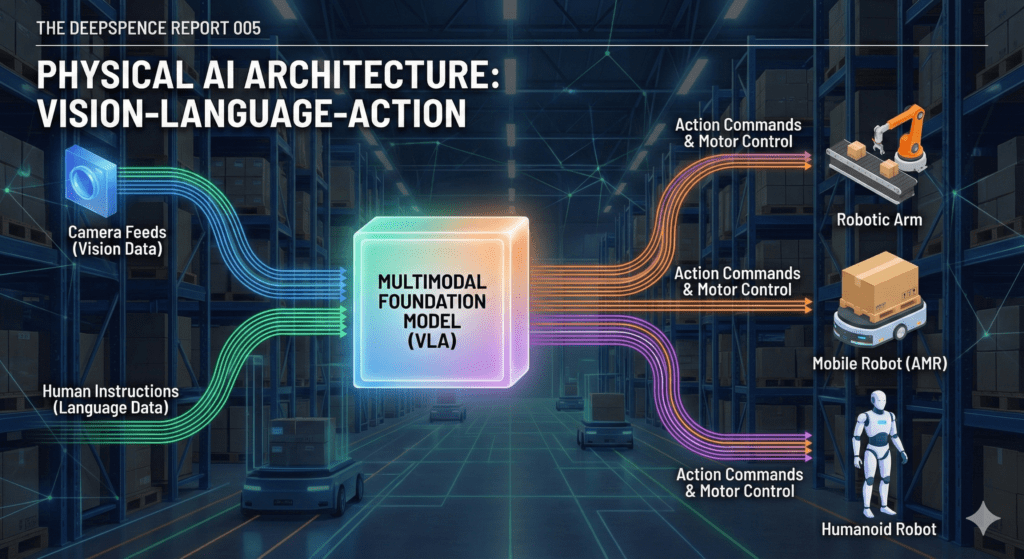
1. The Hottest Trend: Physical AI & Spatial Intelligence
The newest frontier isn’t more text; it’s spatial data. After mastering digital information, AI is now learning to interact with the physical world.
Beyond the Chatbot: Humanoid robots (like Tesla Optimus and Figure 01) are moving from prototypes to production reality, designed to navigate “human spaces” like stairs and narrow aisles.
Vision-Language-Action (VLA): New models allow AI to process camera feeds and execute precise physical movements in real-time, delivering immediate ROI in 24/7 warehouse and manufacturing roles.
The “Digital Nervous System”: Successful businesses are integrating these physical agents into their wider systems, turning factories into “Self-Correcting” environments.
2. The Shift: From Tool to Digital Worker (Agentic AI)
We have officially moved from “single-prompt” workflows to Autonomous Agents.
Proactive Process Control: Models like Claude 4.6 and GPT-5.3-Codex can now decompose a complex goal into subtasks and execute them over multiple steps without human handoffs.
The “Triple-Threat” Worker: Agentic AI now handles customer support tickets, processes refunds, and updates CRMs autonomously.
Self-Evolving Systems: These Physical AI agents use “Mixture of Experts” architectures to perform at elite levels for 1/20th of the previous computational cost.
3. Vertical Dominance: The SLM Revolution
Generic “Ferrari” models (LLMs) are being outpaced in the workplace by “Honda Civic” models—Small Language Models (SLMs).
Niche Precision: SLMs are fine-tuned on specific domain data (Legal, Finance, Manufacturing), providing higher accuracy and lower bias than general models.
Sovereign & Local: Because SLMs require less power, they can run on your local “Sovereign Server,” ensuring your proprietary strategy stays behind your firewall.
Efficiency at Scale: While LLMs are expensive to run, SLMs are economical, allowing even small teams to deploy dozens of specialized agents for a fraction of the cost.
[SOVEREIGN_MOVE]: Don’t Automate a Broken Process
90% of automation failures are process failures, not tech failures. In this new era, your roadmap is simple:
Map the Process: Identify your bottlenecks before you try to plug a robot into them.
Validate via Simulation: Use “Digital Twins” to test your ROI before you spend a dollar on physical hardware.
Build the Infrastructure: You cannot run 2026 Physical AI on a 1990s Excel spreadsheet.
Ready to de-risk your automation strategy? BOOK YOUR SOVEREIGN AUDIT
FAQ: Issue 005 Intelligence
Q: Do I need a humanoid robot right now? A: Likely no. But you do need the Spatial Intelligence and Agentic Workflows that power them to stay competitive in logistics and manufacturing.
Q: What is “VLA”? A: It stands for Vision-Language-Action. It’s the brain of Physical AI that lets it see an object, understand an instruction, and move its physical limbs to complete a task.
Q: Are LLMs becoming obsolete? A: No. LLMs are moving into a “Reasoning & Discovery” role (like OpenAI’s GPT-5.2 in physics/chemistry), while SLMs handle the day-to-day business execution.
Signal > Noise.
Deb Spence Founder, The DeepSpence Report